
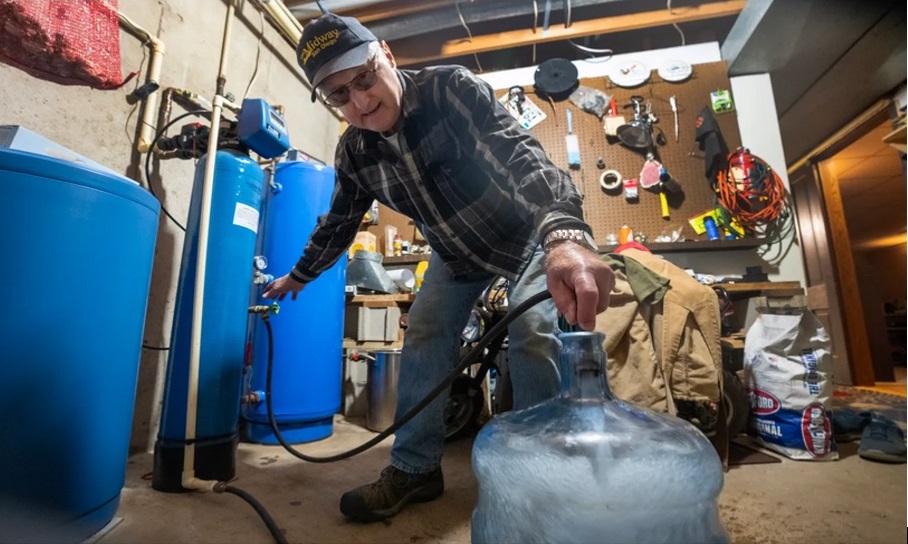
About once a week Charles Wilhelm drives about 20 minutes to his son’s place to fill five-gallon jug of water because his water is contaminated. The Town of Prairie du Sac resident lives about five miles away from the former Badger Army Ammunition Plant, in nearby Baraboo, which leaves behind a legacy of contaminated groundwater affecting area residents. The 7,275-acre plant was built in 1942 to produce smokeless gunpowder for World War II and the Korean and Vietnam wars. He is shown Saturday, August 20, 2025 at his son’s home in the Town of Honey Creek in Sauk County, Wisconsin. Photo by Mark Hoffman/Milwaukee Journal Sentinel
By Madeline Heim and Laura Schulte / Milwaukee Journal Sentinel
Oct. 8, 2025
NORTH FREEDOM, WI – The sprawling grounds of the former Badger Army Ammunition Plant in Sauk County are largely peaceful, long transformed from what was once the world’s largest manufacturer of smokeless gunpowder and rocket propellant for wartime.
Many area residents still have ties to the plant, including Charles Wilhelm, who worked there after a stint in the Navy in the mid-20th century.
Today, the plant’s legacy is why he won’t drink his tap water.
Toxic chemicals produced at the plant leached into the soil and then the groundwater. The problem was first noted as far back as the late 1970s. Wilhelm and his neighbors have lived through a decades-long effort by the Army to clean the mess up.
Dangerous chemical compounds like dinitrotoluene, an explosive used in ammunition production that can cause cancer, continue to be found in elevated levels in groundwater within the former plant’s boundaries. Per- and polyfluoroalkyl substances, better known as PFAS, also have been found on-site. The Army said that is being addressed in a separate investigation.
Some contaminants have traveled off-site via groundwater to people’s homes. As recently as 2019, a residential well was found to have elevated levels of contamination and was replaced.
The Army has spent about $229 million so far on a variety of cleanup methods without success, including extracting contaminated groundwater and excavating soil. Now, they have proposed a new idea that has only been used a few times on explosives: injecting vegetable oil into the soil. The idea is that the oil will stimulate microorganisms to eat the contaminants or degrade them into harmless substances.
The military branch is now at odds with the Wisconsin Department of Natural Resources, which is arguing the Army isn’t assessing the risks to human health stringently enough when it comes to evaluating potential cleanup methods. And although President Donald Trump has previously expressed interest in cleaning up polluted sites faster, it’s unclear how his desire to drastically shrink the federal government could affect the cleanup at Badger.
Meanwhile, residents are still waiting for a solution, uncertain about what comes out of their faucets. For some, it’s a hassle to which they’ve grown accustomed. For others, it’s a source of grave concern and frustration.
Wilhelm drives 20 minutes to his son’s farm in nearby Honey Creek every week to fill up jugs of water that he hauls back to his Prairie du Sac home, where he’s lived for 42 years. He has little faith that the Army’s new vegetable oil treatment will even begin in his lifetime, much less whether it will work.
In an interview with the Journal Sentinel, he recalled a high school civics teacher telling his class that Wisconsinites would never have to worry about their freshwater.
“If he had only lived to see this,” he said.
Toxic waste has leaked into private wells for decades
Drive through the ammunition plant site and you’ll find a labyrinthine network of bumpy roads,signs warning visitors of asbestos dust and the occasional cluster of wells the Army has installed to monitor contamination. The property, which lies near Devil’s Lake State Park, is now owned primarily by the U.S. Department of Agriculture, the Ho-Chunk Nation and the DNR. The DNR has converted a large portion of it to a state recreation area.
But the rural area about 30 miles northwest of Madison used to be something of a metropolis, home to hundreds of buildings and thousands of workers.
The plant was first set up in 1942 to produce ammunition for the military during World War II. Its work paused afterward but resumed during the Korean and Vietnam wars. It permanently ceased operation in 1975.
As ammunition was being produced, workers burned or buried waste in open pits and flushed wastewater into ponds and ditches that drained into Lake Wisconsin, a large reservoir on the Wisconsin River.
Prairie du Sac resident Tom Schwarz recalls his uncle, who worked at the plant, telling stories about disposing the toxic waste, and saying no one realized what they were doing.
Today, the Army has identified four known plumes of contaminants in the area’s groundwater. Three have traveled off the grounds of the former plant.
Laura Olah, executive director of the advocacy group Citizens for Safe Water Around Badger, said the Army issued a release on her birthday in 1990, alerting residents that contamination could be seeping into their water. Shortly thereafter, testing on private wells began, as did monitoring on wells both on- and off-site. The Army ultimately replaced residential wells found to contain unsafe levels of contaminants.
Today, the Army is testing just under 250 wells, about a quarter of them private, at least once every other year. Future plans indicate testing more of the monitored wells and about 20 fewer of the residential ones as the plumes continue to move. It was testing roughly 400 wells a decade ago.
Health assessments from the 1990s and early 2000s did not find unusually high cancer mortality rates or other health hazards in people who drank the water over many years. Still, residents felt uneasy.
In 2011, the Army proposed installing a $20 million municipal water system in the nearby Town of Merrimac that would have given about 400 households permanent relief from water worries in their private wells. Schwarz, who built his house that year, would have been able to drink from it.
But in 2017, Army personnel informed the town that the military had failed to get the proper approval for the project, and it was called off. It was a big disappointment, said Schwarz, who spent his own money to install a water treatment system after testing showed his tap water contained elevated levels of a contaminant.
The promise of the public water system continues to rankle people. Mike Sitton, who chairs Merrimac’s town board, said the town spent $3 million preparing for its installation. After being elected chairman in April, he said he’s tried to re-energize the idea of Army accountability.
“It’s been at least 33 years since my constituents have been subjected to the potential for contamination of their groundwater,” Sitton said. “Enough is enough, in our opinion.”
Interviews with community members for an April 2024 report by the U.S. Army Corps of Engineers reflected frustration with progress at the site. “There is a sense of lack of progress and the Army not being proactive,” the report said.
Army, DNR in conflict over vegetable oil treatment
Vegetable oil injection isn’t a new method of cleaning up contamination.
It’s been used in Wisconsin before to help with the remediation of other contaminants. But using it on explosives is different.
The Army is the only known entity attempting to use vegetable oil in a few locations across the U.S. There hasn’t been much conclusive evidence that it works, but the DNR is hopeful that it could be a cheaper and less invasive solution than digging up millions of tons of soil and hauling it away to be stored somewhere else in perpetuity.
Trevor Nobile, a DNR field operations director for the Remediation and Redevelopment Program, said vegetable oil is like an energy drink for microbes already found in the soil. The Army is hoping to power up the microbes to consume the contamination and break it down.
“You’re helping Mother Nature, giving microbes an energy source so they can do their magic, do their work,” Nobile said.
In Wisconsin, vegetable oil has been successfully used for the clean-up of petroleum and chlorinated contaminants.
Because there’s little proof the method works for explosives, the Army is proposing a number of trials on the land, in addition to some bench testing in a laboratory. If that shows success, the Army can move forward with the remediation plan, which is expected to cost about $46 million.
At the same time, the DNR is in a dispute with the Army about a key, but convoluted, aspect of the plan. More than two years ago, DNR officials wrote to the Army asking it to more rigorously assess the cancer risk to individuals from the groundwater contamination on-site, which would increase the number of contaminants the Army would need to evaluate. Wisconsin state statute says no more than one excess case of cancer in 1 million people due to groundwater contamination is acceptable, while the Army maintains federal law permits one excess cancer case in 10,000 people — a threshold that is 100 times less stringent.
Despite at least three more letters from the DNR, the Army said in a July letter that it would not change course to comply with Wisconsin law. The military said it anticipates the vegetable oil treatment will reduce contaminants to a level the state finds acceptable. There are also residents who are concerned about putting something else in the soil that could potentially get into their wells.
Nobile acknowledged a truckload of vegetable oil spilled on land would generate concerns and potential detrimental effects. But he said targeted injection isn’t a spill.
“What’s injected will be used and consumed by bacteria,” he said. “There aren’t the same type of exposure concerns.”
The U.S. Department of Agriculture, which uses its portion of the site to study dairy forage, declined to comment to the Journal Sentinel about the proposed plan. However, public comments submitted from the department to the Army detail its worries about oil injection and the equipment needed to install it having a negative impact on cropland.
Nevertheless, the Army is moving forward, slowly, with its vegetable oil plan. The testing process could begin in 2026 and take about two years, Army officials said at a community meeting in January.
Residents impatient with slow progress on solutions
All of it hinges on securing funding, a dicey proposition in Washington at the moment. Quang Nguyen, a regional team leader for the Army’s Environmental Command, noted at a July community meeting that the “Army has been working more with less lately.”
“As far as I can tell, they’re spending enough money on studies to pay for the (water) system,” said Craig Hamilton, who’s lived in Merrimac for half a century.
He wants the Army to foot that bill, as it once offered, and then turn back to cleaning up the plumes, which he said could be studied “for 100 years.”
Mike Gleason, vice president of the Lake Wisconsin Alliance, moved permanently to the area five years ago but had been vacationing there for years. Even when he was living in Chicago, he said he’d make the drive to meetings about the contamination at Badger, where 50 or more people used to show up. Today, he said, it’s dwindled.
“It’s as if (the Army’s) goal is to wear us out instead of resolving the issue,” Gleason said.
As years go by, more people are moving to Merrimac. The town’s population, though small, grew more than 30% between 2010 and 2020, census data show. Sitton worries that building more houses near contaminated water could be dangerous, especially if new residents don’t realize it.
Schwarz said he trusts the Army wants to do the right thing. It’s a good sign the military hasn’t abandoned the cleanup completely at this point, he said.
Others view its actions in a dimmer light, especially the latest conflict with the DNR over how much risk to human health is permitted. Olah, of Citizens for Safe Water Around Badger, feels it could set a precedent for the numerous sites across country contaminated by Department of Defense activities, especially because of the presence of PFAS.
“If they’re able to say, ‘DNR, we don’t have to listen to you here,’” she said, “what’s going to prevent them from doing it elsewhere?”
At the site, buried underground, the plumes of contamination are still moving, changing direction over the years. For some who live near the site, that’s a source of constant unease.
“You’re guessing where this stuff is going to go, and maybe they’re good guesses. But nobody is 100% (sure),” Gleason said. “The concern people like me have is, when is my well going to get polluted? … It could happen to anybody. That’s the frustration.”
Historical PHOTOS of the former Badger Ammunition plant Milwaukee Journal Sentinel 2025