By Joe Block, The Independent Star News, July 31, 2025 (Images added by CSWAB.org)
As Army officials continue the bureaucratic process involved with the cleanup of the former Badger Army Ammunition Plant in southeastern Sauk County, they held a public information meeting July 17th to bring residents up to speed. The proposed treatment of polluted groundwater through the injection of emulsified vegetable oil will receive a “test pilot” prior to full roll out.
The timeline for that test plot is about two years.
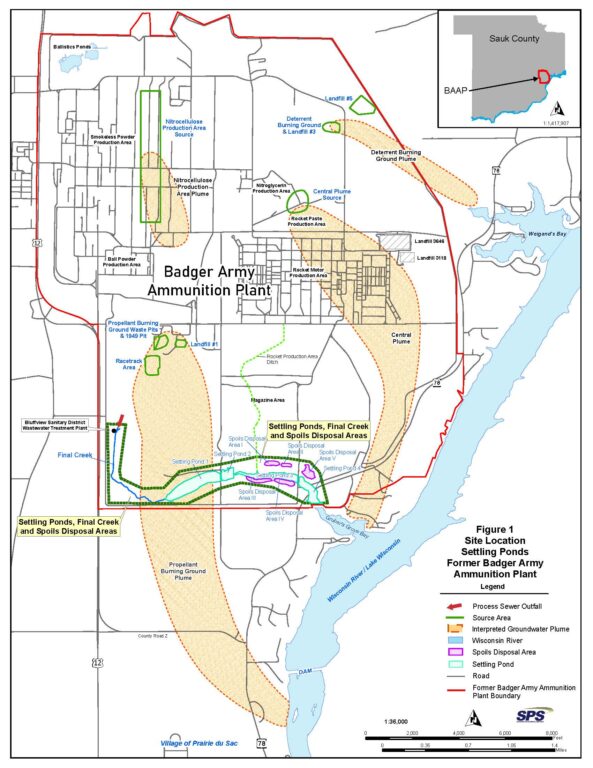
The former ammunition plant contains four primary “plumes” of polluted groundwater heading southeast towards the Wisconsin River. A host of monitoring wells detect the concentrations of the various toxic contaminants present. The Army also tests residential wells in the area, and if a contaminant is detected, the family is put on bottled water until a new well is installed.
The Army’s proposed solution for contaminated groundwater in and around the former plant, and the focus of the test pilot is in-situ anaerobic bioremediation. Via wells drilled into the groundwater supply, the Army will inject nutrient-enriched emulsified vegetable oil. The enriched vegetable oil will be “distributed into groundwater using food-grade oil, surfactants and clean water. Wells would be drilled at spaced intervals throughout each plume. This is considered a green remediation process.
Groundwater sampling data were presented at the meeting, with mixed results, showing more or less stable contamination levels at sampled wells. The Army announced their plan for well water sampling going forward. The Army samples both specially installed test wells as well as residential wells in the area surrounding the Badger Army Ammunition Plant. A recent change announced at the meeting was a reduction in sampling certain residential wells. Specifically, in the wells evaluating the Deterrent Burning Ground, residential wells located on the southwestern arm of Weigand’s Bay will be dropped from monitoring.
About 18 residential well will be dropped from regular testing. The contamination plume lies about 2000 feet north northwest of the residences. In addition, the plume is upgradient from the wells. A nest of four test wells lies between the residences and the plume.
Laura Olah, Executive Director of the local group Citizens for Safe Water around Badger, raised concerns about groundwater flow varying over time as the water table fluctuates in the area, meaning wells in the path of the contamination plume may vary over time too. Army officials at the meeting also noted that the treatment system may affect groundwater flows in the area.
Because of this, Olah supported “more offsite drinking water wells and for more contaminants, not fewer.”
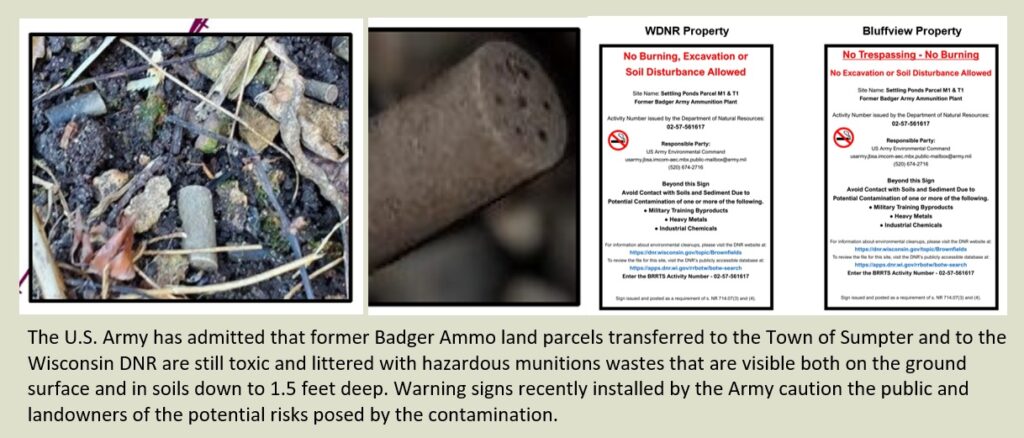
At the previous meeting the Army reviewed the site inspections of the settling grounds area, revealing soil contaminated with propellant products and byproducts — at times simply lying in chunks on the surface of the ground. The degree of pollution shocked those present, with one advisory board member calling it “disgusting.” After a delay of a few months, signs (above) have been installed on the property to warn anyone trespassing of the polluted land.
The Army holds public meetings with the Restoration Advisory Board quarterly.