
By Joe Block, Independent Star News, Front page, August 6, 2026
WISCONSIN – Investigations into an August 2020 prescribed burn at the former Badger Army Ammunition Plant that raged out of control and produced “multicolored smoke and high-intensity flames, “according to the Wisconsin Department of Natural Resources, have revealed the Army failed to clean up “contamination from a previously identified hazardous substance release for which [they] were responsible.”
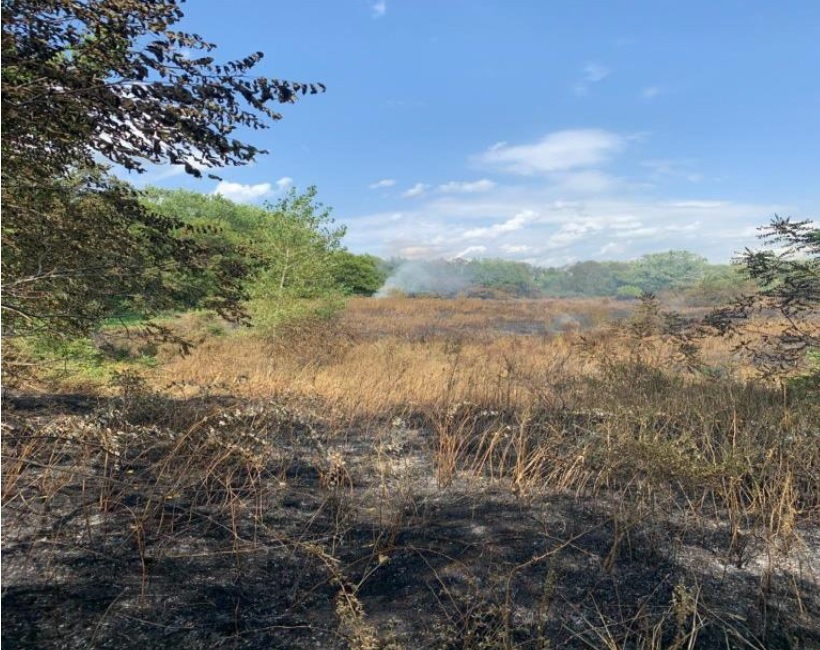
The burn occurred in the town of Sumpter on Keller Road along the southern border of the former plant boundary. A voluntary evacuation order was briefly in place. Fire officials decided to let the underground fire burn, and heavy rain extinguished it a few days later (photo above).
The area includes a series of interconnected settling ponds that received wastewater during the plant’s operation. Despite a previous cleanup by the Army, contamination is worse than expected.
Soil inspection and sampling revealed dinitrotoluene, or DNT, used as a propellant deterrent, is present at levels that exceed the soil cleanup goals approved by the WDNR in 2014. Further, soil sampling in June 2021 detected two forms of DNT at concentrations exceeding the soil cleanup goal. In May 2026, the WDNR requested that the Army test for all six isomers of DNT as the settling ponds investigation moves forward.
The study of the settling ponds showed the presence of high explosives at Badger — specifically TNT, RDX and HMX — in surface and subsurface soils. Testing also reconfirmed elevated concentrations of other energetic compounds, including forms of dinitrotoluene (2,4-DNT and 2,6-DNT) and nitroglycerin, as well as unburned propellant grains scattered on the soil surface.
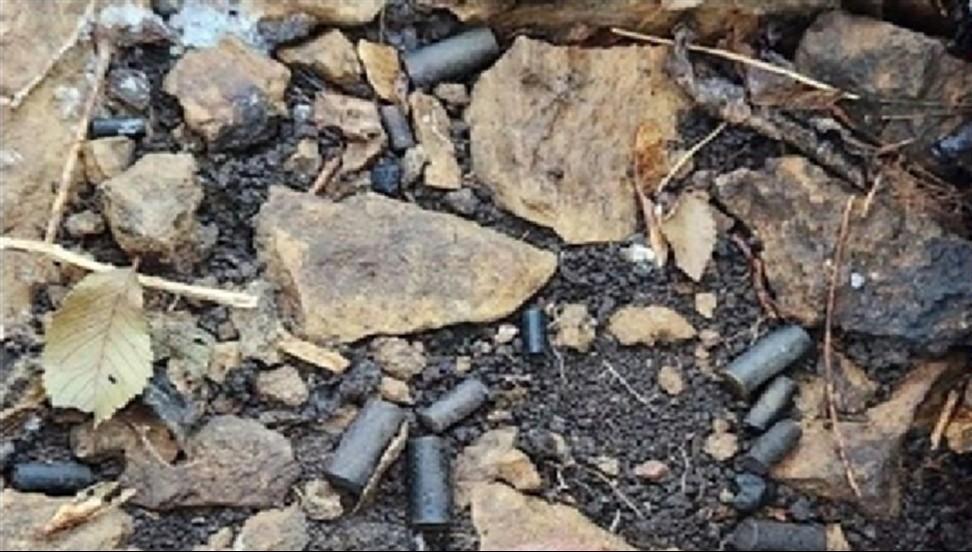
The unburned propellant grains on the ground (photo) on-site were described by Joel Janssen, of SpecPro, who conducts much of the sampling:
“So there are three different sizes that we found, an eighth of an inch to a quarter inch in diameter, and three eights inch to three quarters of an inch. So some are very small. Some are fatter. Some have different colorations depending on maybe when it was made, maybe different type of manufacturing process for a different division of army or navy, they made a lot of different propellant for various runs.”
Janssen also explained how the grains ended up in the settling ponds: “During production, with the water that was flowing through it, millions of gallons per day. It was being deposited along just like a pebble, because it came through the production sewers before it entered Final Creek.”
As for the grains’ explosive nature, Janssen said: “You can keep them wet. I mean, if they stay wet and moist, there is absolutely no hazard to them. You cannot do anything with a wet grain.” However, he added, “if you were to dry them out, yes, they would be dangerous.” He continued, “Yeah, if you did have a fire, like, you know, the fire, if you had a fire and it was constantly at a certain temperature, you could dry the grain out. Yes, you would. It would burn the grain out.” Explicitly classified as “toxic propellant grains,” they consist of energetic propellants made with hazardous compounds such as DNT and nitrocellulose. DNT is toxic to humans, wildlife and aquatic organisms, with chronic exposure linked to organ damage.
At an April 16, 2026 meeting of the Badger Advisory Board, composed of interested stakeholders in the area, Laura Olah, from Citizens for Safe Water Around Badger, directly asked Quang Nguyen, Team Lead, Midwest and Central America Division at the U.S. Army Environmental Command (USAEC), about the presence of high explosives in groundwater at Badger.
“Does Army have enough information right now to convince all of us that there’s no high explosives in the groundwater around Badger, at and around Badger right now?” asked Olah.
“I’m not sure,” was Nguyen’s answer.
Restoration Advisory Board members have repeatedly expressed concern at meetings with the Army about the movement of high explosives off-site in groundwater, as well as the slated oil emulsion injection, which could mobilize contaminants in the ground-water.
The Army’s solution for now is signs. Long-term, it’s the same Kafkaesque bureaucracy as before: multiyear acronym-laden processes to obtain funding and approval. Yet there’s no solace in those processes, as the Army has even done them incorrectly.
Finally at Badger, there is growing concern — as in the rest of the country and world — regarding PFAS.
As always with the Army, testing is contingent upon funding. The existence of PFAS at Badger, confirmed along the southern boundary, raises the stakes for the cleanup. ♦
CSWAB Postscript…
Today, nearly 6 years after the underground fire, prescribed burning of vegetation on the former Badger Army Ammunition Plant lands remains strictly prohibited by the WDNR. It’s hard to imagine that the former Settling Ponds are the one and only area at Badger that has the potential for residual energetic hazardous waste contamination.
CSWAB first petitioned for regulation of the explosive dinitrotoluene (DNT) in 2006 when it became evident that adequate cleanup of Badger and other contaminated military sites would only be achieved with enforceable state standards. On January 1, 2011 the State of Wisconsin adopted groundwater standards for all six isomers of DNT. The new health-based standard, measured as the summed total concentration of all DNT isomers, is 0.05 micrograms per liter (ug/l) — setting a national health-based precedent for “total” DNT in groundwater.
In May of 2026, the Wisconsin Department of Natural Resources (WDNR) issued a formal comment letter directing the Army to analyze contaminated soils at Badger Army for all 6 isomers (forms) of the chemical compound dinitrotoluene (DNT). For decades, the Army has minimized the risks to human health and the environment by testing impacted soils for only 2 isomers (2,4- and 2,6-DNT).
The WDNR letter states: “Given that BAAP utilized technical grade dinitrotoluene (DNT), the detections of 2,4- and 2,6-DNT in soil noted in the Report, the existence of a Wis. Admin. Code NR 140 Enforcement Standard for total DNT (inclusive of all six isomers), and detections of all six isomers of DNT in groundwater throughout the broader BAAP Site, the RI should evaluate soil for all six isomers of DNT for potential direct contact risk and possible leaching to groundwater. The next workplan for additional investigation should include details regarding sampling and analysis of soil for all six isomers of DNT.”
In addition to military propellants like DNT, a recent Army study confirmed that the presence of high explosives such as RDX, HMX, and TNT in Badger soils which is significant as they have never been included in the routine testing of groundwater and drinking water wells at and near the former Badger lands. For decades, the Army has argued that testing for high explosives was not warranted because they were not used in the manufacturing process at Badger.
In August 2023, the Army submitted a draft remedial action plan to the WDNR for addressing community-wide groundwater contamination but the plan omits PFAS and high explosives altogether. And while testing has confirmed that both are present in groundwater flowing beneath the former Badger property, the Army has flatly refused to test nearby residential wells. Badger is the source of three separate groundwater contaminant plumes that have all migrated beyond the plant boundary into nearby residential areas that rely on groundwater for their drinking water.
A WDNR August 17, 2020 letter requires the U.S. Army at Badger to include evaluation of PFAS and other emerging contaminants “as early in the cleanup process as possible, preferably during the site investigation phase.” In a follow-up letter to the Army on September 9, 2020, the Department stated its opinion that there is “considerable uncertainty regarding potential discharges of PFAS” at Badger.
On January 26,2023, community members of the Badger Restoration Advisory Board (RAB) passed a resolution calling on the WDNR to expand environmental testing requirements to include “ALL six (6) forms of the explosive DNT at and near the former Badger Army Ammunition Plant, and to identify and enforce protective cleanup goals for all known and suspected contaminants including PFAS, mercury and asbestos.”
Badger RAB Resolution Settling Ponds after the Burn January 2023
Map Badger Army Settling Ponds Final Creek Spoils Disposal Area 2025
WDNR Letter Requiring Army to Test Soil for all 6 DNT Isomers May 2026
– end –